
How to Name Custom Order Statuses Customers Actually Understand
Short labels plus useful descriptions do more work than long status names ever can. Here is how to write both halves so customers get the answer on the first read.
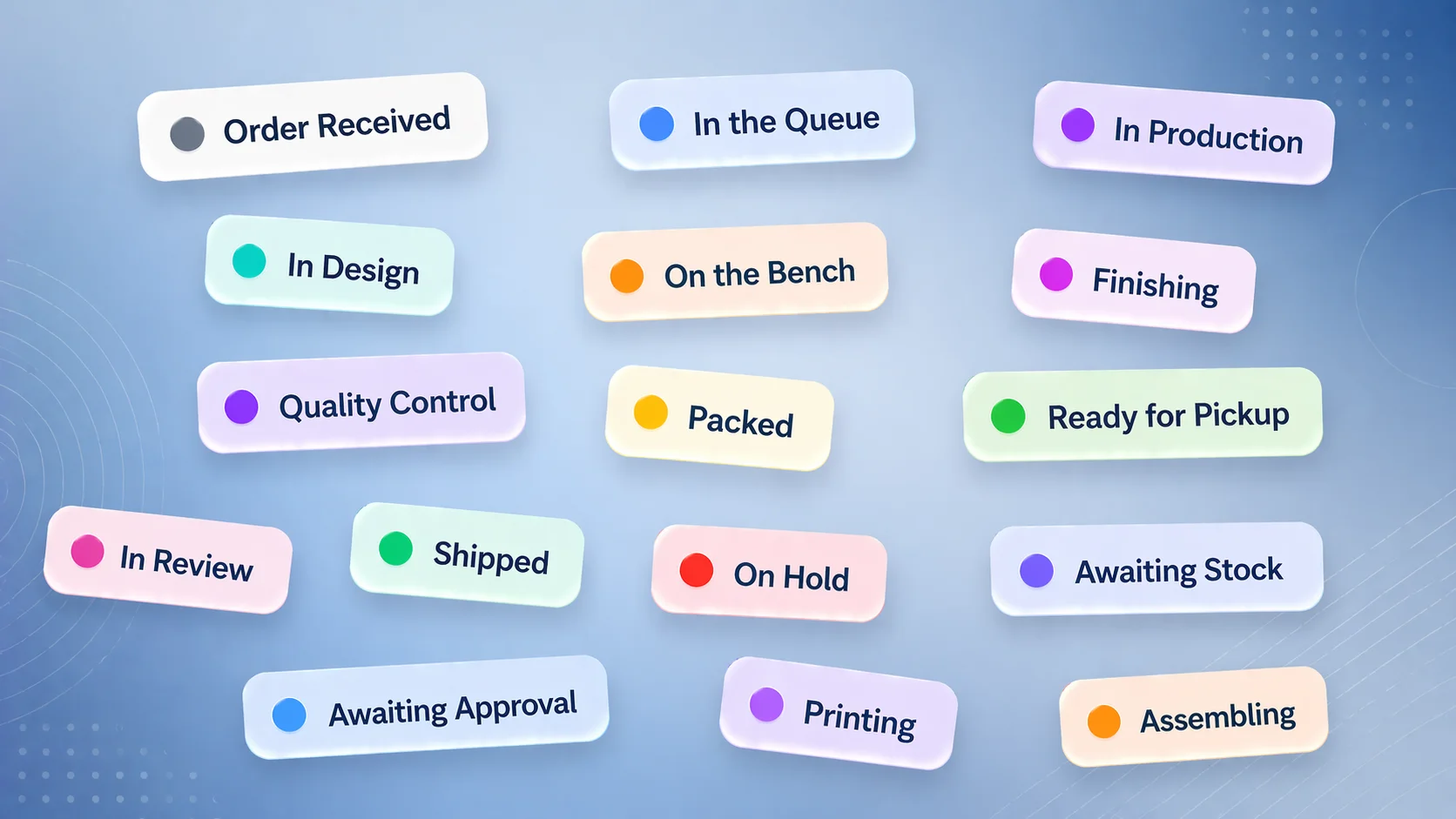
Names are short, descriptions do the work
Most brands spend hours on product copy and almost no time on the label that every paying customer looks at three or four times. That label is the order status.
A status is not a database field. It is a sentence the customer reads during a moment of mild anxiety. Good statuses reduce that anxiety. Bad ones create support tickets.
But the label is only half the story. Every decent order status page shows a short name and a one-line description beneath it. Those two pieces have different jobs, and most of the mistakes merchants make come from trying to make one half do the other's work.
The label and the description have different jobs
The label answers one question at a glance: what stage is my order in? Two or three words. The customer scans a vertical list of stages and needs to orient immediately.
The description answers the next two: what is happening right now, and is this normal? That is where reassurance, present-tense action, and "what comes next" belong.
If you try to make the label do all three, it gets long, and long labels stop being labels. They become sentences in a list, and the scannability is gone.
Write both for the customer, not the warehouse
Internal names describe operations. "Picked," "QC'd," "Manifest generated." Those are fine for your team. They are not fine for the order page.
The same applies to descriptions. "Manifest uploaded to carrier portal" is an operations line. "Handed to the courier for collection later today" is a customer line.
If either half only makes sense to someone who works at your company, rewrite it.
Keep labels short and consistent
Pick a grammatical form and hold it across every stage. Noun phrases work well: "Order received," "In production," "Packed," "Shipped." So do present-progressive verbs: "Producing," "Packing," "Shipping." Mixing the two feels disjointed, even if customers cannot explain why.
Two or three words is the target. Once a label runs to five or more, it has stopped being a label.
Let the description carry the present tense and the next step
Labels are allowed to be past-tense as long as the description tells the customer what is happening now and what comes next.
- Shipped: Handed to the courier for delivery.
- Packed: Boxed and labelled, waiting for carrier pickup.
- On hold: Waiting on a restock of one item. We will update this page as soon as it arrives.
In each pair, the label is scannable and the description does the reassurance work. Neither half tries to do the other's job.
Design the delay-friendly version
Every pair should still make sense when the stage takes longer than normal. "Processing" alone is fine for an hour. After three days it reads as abandonment.
The fix is almost always in the description, not the label. Processing paired with In the queue for our workshop. Current lead time is 3-5 business days holds up on day three. The same label with no description does not.
Before finalising a pair, ask what it will sound like on day five. If the description starts feeling evasive, rewrite it.
Test the pair on someone outside your team
The fastest sanity check is to show each label-and-description pair to someone who does not work on the store. If they can describe what is happening to the order in their own words, the pair works. If they hesitate, it needs another pass.
Thirty minutes of editing saves hundreds of support replies.
A worked example: an embroidery shop
Seven stages for a Shopify store that embroiders apparel to order. Labels are short and consistent; descriptions carry the reassurance.
- Order received: Your order and artwork are in. Digitising is next.
- Digitising: Converting your artwork into a stitch file. Usually the longest step before the machine runs.
- Queued for stitching: Threads matched, garments prepped. Waiting for an open machine.
- Stitching: Your design is being stitched right now.
- Trimming & QC: Loose threads removed and every stitch checked before packing.
- Packed: Boxed and labelled, waiting for carrier pickup.
- Shipped: Handed to the courier for delivery.
Read the labels down the left and it reads like a table of contents. Read the descriptions and every stage feels in motion. That is the bar.
Final takeaway
A custom status is a pair: a short label the customer can scan, and a description that tells them what is happening and what comes next. Get both halves right and the order page becomes something customers trust instead of interrogate.
StatusPro lets Shopify merchants design both halves of every custom status quickly, so the words on the order page match the experience you want customers to have.